Commercial Floor Sanding in South West London, SW11
Commercial timber floors in South West London, SW11 take a different sort of punishment from domestic boards. Offices around Clapham Junction, busy shops on Northcote Road, pubs and restaurants off Battersea Rise, clinics, gyms and public buildings can put thousands of shoes, chair castors, delivery trolleys and cleaning cycles across the same floor every week.
Once the original lacquer has worn through, timber starts taking the damage directly. Dirt works into open grain, cleaning chemicals attack weakened coatings, board joints become grime traps and polished traffic lanes can become noticeably more slippery than the surrounding floor. Our work is aimed at putting the timber back into a condition that is practical to clean, safe to use and fit-for-purpose for the way the premises actually operates.
We undertake Commercial Floor Restoration in South West London, planned Commercial Floor maintenance in South West London and Commercial Floor Polishing in South West London for occupied and vacant commercial buildings throughout SW11 and the surrounding South West London area.
That includes private offices, coworking and serviced offices, shops, boutiques, showrooms, restaurants, cafés, pubs, takeaway units, factories, workshops, storage and distribution premises, gyms, cinemas, studios, hotels, hostels, clinics, dental practices, schools, colleges, universities, academies, churches, mosques and temples.
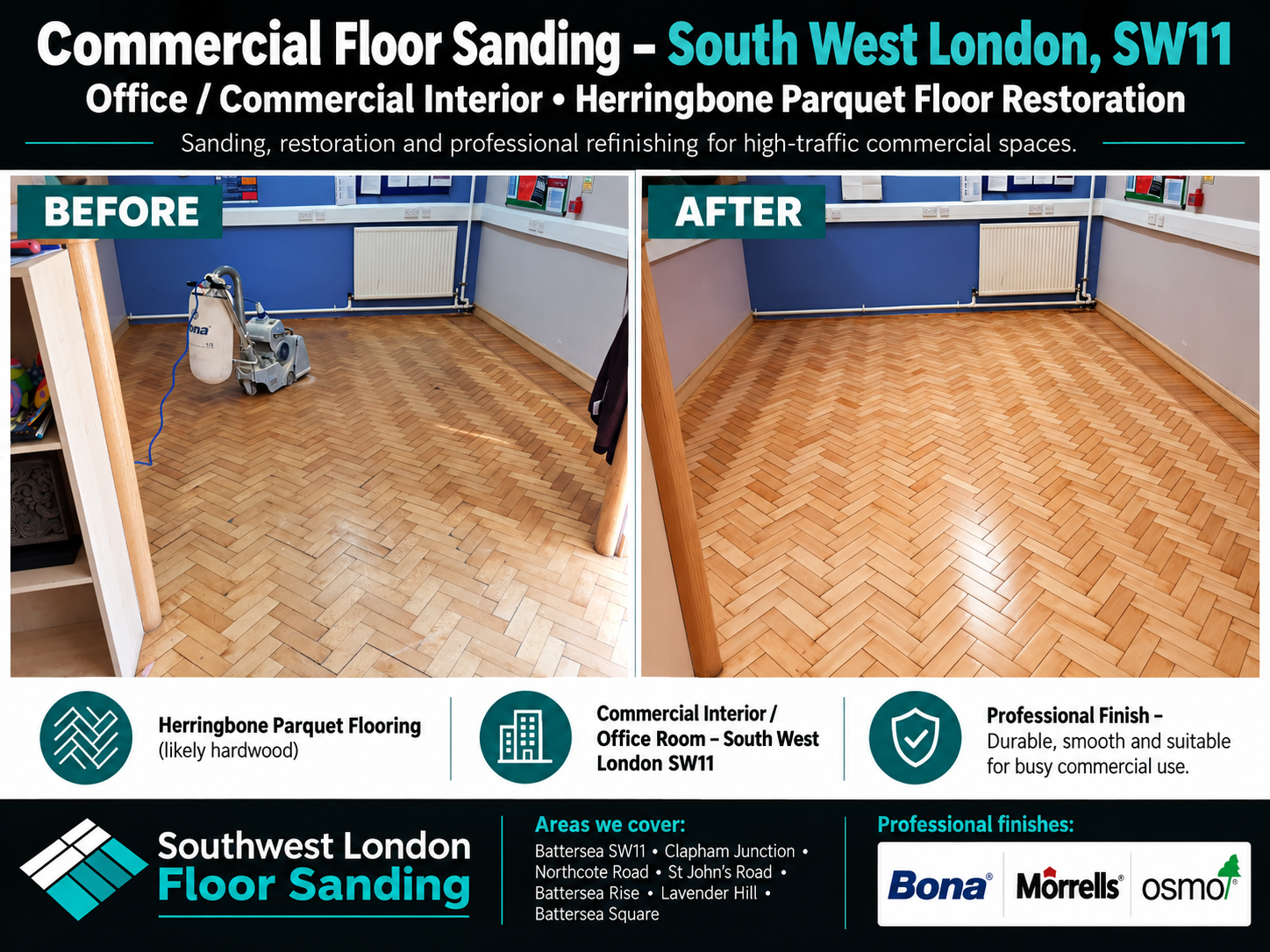
Commercial herringbone parquet floor restoration in South West London SW11, showing the office floor before sanding and the clean, professionally refinished result.
Commercial Timber Floors in SW11 Need More Than a Domestic Sand and Varnish
SW11 has a broad mix of buildings, and the flooring problems vary with them. We regularly encounter suspended timber floors in Victorian conversions, older pitch-pine boards in institutional buildings, parquet blocks in halls and meeting rooms, oak strip flooring in offices and retail units, and modern engineered boards in refurbished commercial interiors.
Clapham Junction and Battersea contain busy retail, hospitality and office premises, while Northcote Road, St John’s Road, Battersea Rise and Lavender Hill have a particularly high concentration of shops, restaurants and customer-facing businesses. Battersea Park, Clapham Junction and Battersea Square also sit within recognised conservation areas, so older premises often contain original timber elements that are worth repairing rather than automatically replacing.
The first job is therefore not choosing a sanding grit. It is establishing what the floor is made from, how it has been fixed, how much usable timber remains above the tongue or wear layer, what coatings are already present and what demands will be placed on the finished surface.
Typical Commercial Floor Problems We Find
- Worn traffic lanes: reception areas, bar approaches, shop entrances and corridors often lose their protective coating long before the rest of the floor.
- Open board joints: gaps collect grit, food debris and cleaning residue and can become difficult to maintain hygienically.
- Loose parquet: individual blocks may sound hollow, rock under load or release where an old bituminous or brittle adhesive bed has failed.
- Moisture ingress: leaks, wet-cleaning regimes, cellar humidity and damp substrates can cause cupping, edge lift and adhesive failure.
- Slip-risk concerns: inappropriate polishes, grease contamination and over-smooth coatings can reduce traction, particularly at entrances, bars and food-service areas.
- Chair and trolley damage: castors, pallet movements and metal furniture feet can cut through comparatively soft domestic lacquers surprisingly quickly.
- Chemical degradation: concentrated detergents, sanitisers and unsuitable degreasers can cloud, soften or gradually strip certain finishes.
- Historic over-sanding: older floors may already have been sanded several times, leaving limited material over the tongue-and-groove joint.
Our Commercial Floor Restoration Process
A commercial restoration should be specified from the floor upwards, not from the tin of lacquer downwards. Before machinery arrives, we establish the substrate condition, access restrictions, working hours, isolation requirements and the point at which the client needs the area back in service.
Step 1: Subfloor Audit & Moisture Testing
We start by identifying the timber and floor construction. Quartersawn oak behaves differently from Victorian pine, pitch pine has a very different resin content from modern softwood, and teak or other naturally oily timbers require particular care with surface preparation and coating compatibility.
Loose boards, deflection, failed fixings, hollow parquet blocks and previous repairs are marked before sanding begins. Where moisture is suspected, readings are taken from the timber and, where the construction demands it, the substrate is checked with appropriate hygrometer testing before adhesive or coating work is specified.
This matters particularly in basement restaurants, ground-floor retail units, workshops and buildings that have suffered plumbing leaks. Sanding a damp floor may improve its appearance for a few weeks, but it does not correct the underlying movement that caused the failure.
Step 2: Timber Repairs, Re-Bonding & Resin Gap-Filling
Damaged sections are repaired before final sanding so that the new material can be levelled into the existing floor. Wherever practical we match the original species, board dimensions and grain character rather than inserting an obviously unrelated piece of timber.
Loose parquet can be lifted selectively, cleaned and re-bonded using a suitable flexible adhesive system. On compatible installations we use modern silane-based parquet adhesives because they retain a degree of elasticity, accommodate normal timber movement and are available in low-emission formulations including products carrying EC1 Plus classifications.
Fine and stable gaps can often be treated with a resin-slurry system produced from clean sanding dust and a compatible resin binder. Wide seasonal gaps, moving boards and structurally unstable joints are assessed individually; filling a joint that is designed to move merely transfers the problem elsewhere.
Step 3: HEPA Dust-Controlled Sanding & Surface Preparation
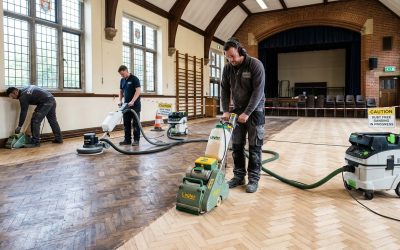
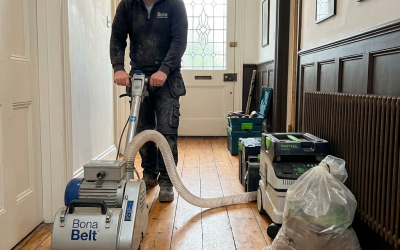
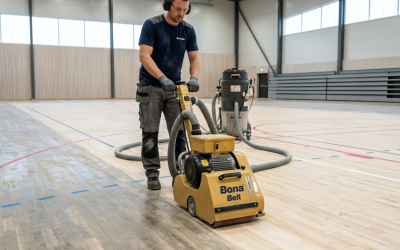
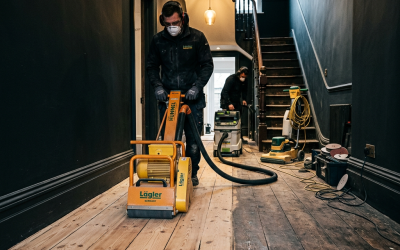
For open commercial areas we commonly use professional belt sanding equipment such as the Lägler Hummel rather than lightweight domestic hire machines. A correctly set belt sander removes failed coatings consistently and keeps the floor flatter, which is important on large offices, halls, shops and restaurant areas where uneven sanding shows badly under lighting.
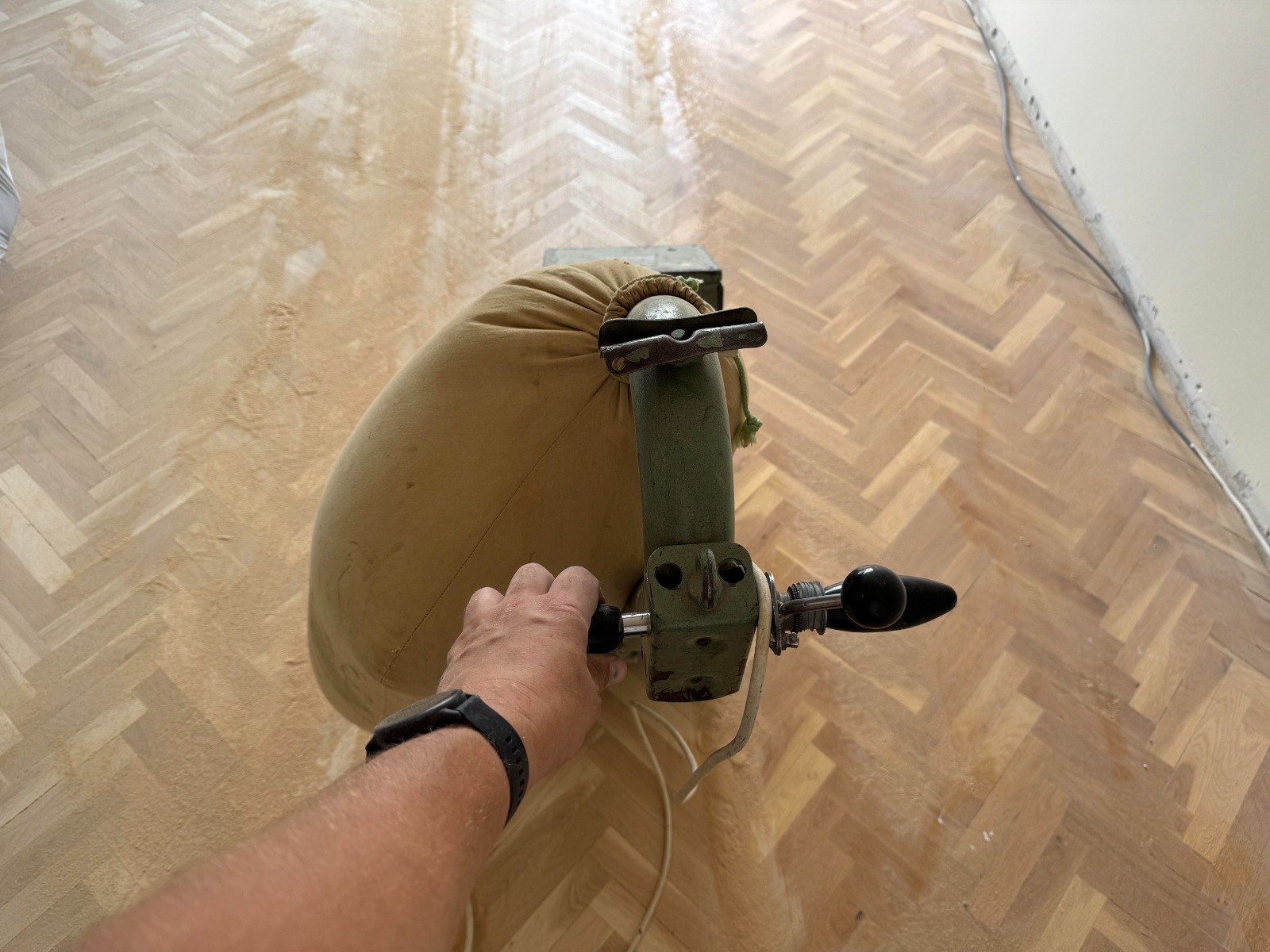
The main sanding sequence is matched to the amount of coating and damage present rather than following a fixed grit recipe. Heavy contamination may require an aggressive initial cut, followed by progressively finer abrasives, edging, corner detailing and rotary finishing to remove scratch patterns before coating.
Dust control is treated as part of the job, not an optional extra. Where the site specification requires it, sanding machinery and auxiliary tools can be connected to high-efficiency extraction using HEPA H14 filtration, with work zones isolated to reduce migration into adjoining offices, stock areas, treatment rooms and public circulation routes.
Wood dust is a workplace health issue and is addressed within the project COSHH assessment and RAMS. This is particularly important on occupied premises where staff, customers, cleaners and other contractors may remain elsewhere in the building.
Step 4: High-Traffic Finishes – 2K Lacquers, Hardwax Oils & Anti-Slip Systems
The finish is selected around traffic, cleaning routine, appearance and downtime. A boutique showroom does not have the same coating requirement as a pub entrance, dental practice, school corridor or distribution office adjoining a warehouse.
For heavily used commercial timber, a two-component waterborne polyurethane is often the sensible specification. A 2K system uses a separate cross-linking catalyst to produce a tougher cured film than many single-component domestic products, giving better resistance to abrasion, repeated cleaning and chair movement.
Waterborne systems also avoid the heavy solvent loading associated with many older commercial lacquers. Where indoor-air requirements are particularly strict, we can build the specification around compatible low-emission primers, adhesives and products with recognised emission classifications rather than choosing purely on sheen level.
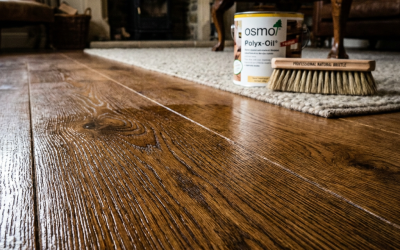
Hardwax oil remains useful where a more natural, repairable surface is preferred, particularly in character properties and lower-impact commercial areas. It is not automatically the right answer for every restaurant, bar or high-volume public corridor, so maintenance expectations need to be agreed before specification.
Where slip resistance is a particular concern, the complete system has to be considered: timber texture, coating, contamination, cleaning procedure and expected wet conditions. For sites requiring formal verification, slip performance can be considered against Pendulum testing methodology described in BS 7976 and associated UK slip-resistance guidance rather than relying on vague claims such as “non-slip”.
Step 5: Aftercare & Commercial Maintenance Protocols
A newly restored commercial floor should not be handed over without a realistic cleaning and maintenance plan. Many premature coating failures come from concentrated chemicals, steam cleaning, excessive water, dirty entrance matting or repeated use of polish products that are incompatible with the lacquer beneath them.
We explain initial cure restrictions, routine cleaning, spot-treatment procedures and when periodic maintenance coats should be considered. On high-footfall sites, dealing with wear while the coating is still intact is substantially less disruptive than waiting until bare timber is exposed.
Our floor sanding prices page gives a useful starting point for budgeting, although commercial work is normally priced after the floor area, repairs, working hours and coating system have been established. You can also view examples of completed timber work in our floor sanding gallery.
Floor Sanding for Offices, Shops, Restaurants and Public Buildings
Offices, Coworking Spaces & Serviced Offices
Office floors usually suffer most beneath desk chairs, around tea points, reception desks and the routes between lifts, doors and meeting rooms. The work often has to be completed around tenants, IT equipment, access-control systems and weekday occupancy.
We can divide larger floors into controlled sections and programme sanding outside normal working hours. Furniture moves, curing periods and reinstatement are agreed before work starts so Monday-morning occupation is not left to chance.
Shops, Boutiques, Showrooms & Shopping-Centre Units
Retail floors have concentrated wear at entrances, till points, changing rooms and merchandising routes. Stock protection, shopfront security, delivery access and strict reopening times are normally as important as the sanding itself.
For Northcote Road, St John’s Road, Lavender Hill and Clapham Junction premises, out-of-hours working can reduce interruption to trading. Where access is constrained, we plan machinery movements and waste removal so common parts and neighbouring traders are not unnecessarily obstructed.
Restaurants, Cafés, Pubs & Takeaway Units
Hospitality floors face grease, spilled drinks, frequent mopping, chair movement and abrasive grit carried through the entrance. A domestic polish laid over a poorly prepared surface will not deal with those conditions for long.
Kitchen thresholds, bar fronts, service routes and toilet approaches are checked carefully because these are the points where moisture and contamination commonly reach the timber first. Coating cure times are programmed against reopening, with heavier furniture and aggressive cleaning held back until the finish has developed sufficient hardness.
Factories, Workshops, Storage & Distribution Premises
Timber floors in workshops and older industrial premises can contain localised oil contamination, impact damage and previous patch repairs. We first determine whether the floor remains structurally suitable for restoration and whether contamination has penetrated too deeply for conventional sanding alone to resolve.
Battersea’s commercial fabric includes office, light-industrial and distribution uses, particularly around the wider Battersea Business Quarter. In these premises, phased access and safe segregation from deliveries, plant movements and warehouse activity are normally central to the method statement.
Gyms, Cinemas, Event Venues & Studios
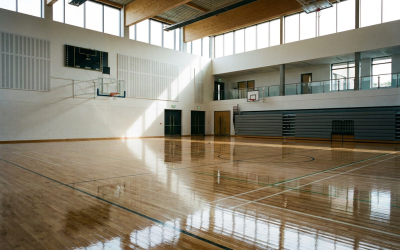
These sites place very different loads on timber, from concentrated gym equipment to hundreds of visitors arriving in a short period. Surface grip, impact damage, furniture movement and the need to turn the building around quickly between bookings all influence the specification.
Hotels, Hostels & Serviced Accommodation
Corridors, breakfast rooms, receptions and stair approaches can seldom be taken out of service together. Sectional restoration allows one route to remain operational while another cures, with noisy sanding programmed around guest occupation where possible.
Clinics, Dental Practices & Treatment Rooms
Dust containment, odour, cleanability and scheduling are particularly important in clinical environments. Treatment areas may need to be isolated completely, and low-emission products can be specified where indoor-air considerations are a priority.
Schools, Colleges, Universities & Academies
Education buildings often contain parquet, strip oak or old softwood boards that have already survived several generations of pupils. Holiday periods provide the most practical working window, but the coating system still has to be chosen with reopening dates, desk installation and cleaning schedules in mind.
Churches, Mosques, Temples & Community Buildings
Places of worship frequently contain older timber with considerable character, but they also experience concentrated foot traffic during services and community events. Repairs need to respect the existing floor while providing a maintainable surface for regular public use.
Commercial Floor Sanding Without Unnecessary Business Disruption
The sanding machine is only one part of a commercial job. Keys, alarm procedures, loading access, lift use, noise restrictions, extraction routes, power availability, fire exits and responsibility for moving furniture all need to be settled before the first belt goes on the machine.
Where premises remain operational, we can plan night-shift, weekend or sectional working. The correct approach depends on the floor layout and, critically, the coating cure time required before people, furniture or wheeled traffic are allowed back onto the surface.
| Working Arrangement | Operational Benefit | Typical Facility Suitability |
|---|---|---|
| Overnight / Out-of-Hours | Reduces disruption during customer or staff hours and allows noisy sanding to be completed when the premises is closed. | Retail units, restaurants, cafés, offices, clinics, gyms and showrooms. |
| Weekend Phased | Creates a longer uninterrupted sanding and coating window while limiting weekday closure. | Offices, schools, clinics, coworking premises and commercial receptions. |
| Sectional Restoration | Keeps part of a larger premises accessible while individual zones are repaired, sanded, coated and cured. | Hotels, serviced offices, large shops, educational buildings, halls and multi-room facilities. |
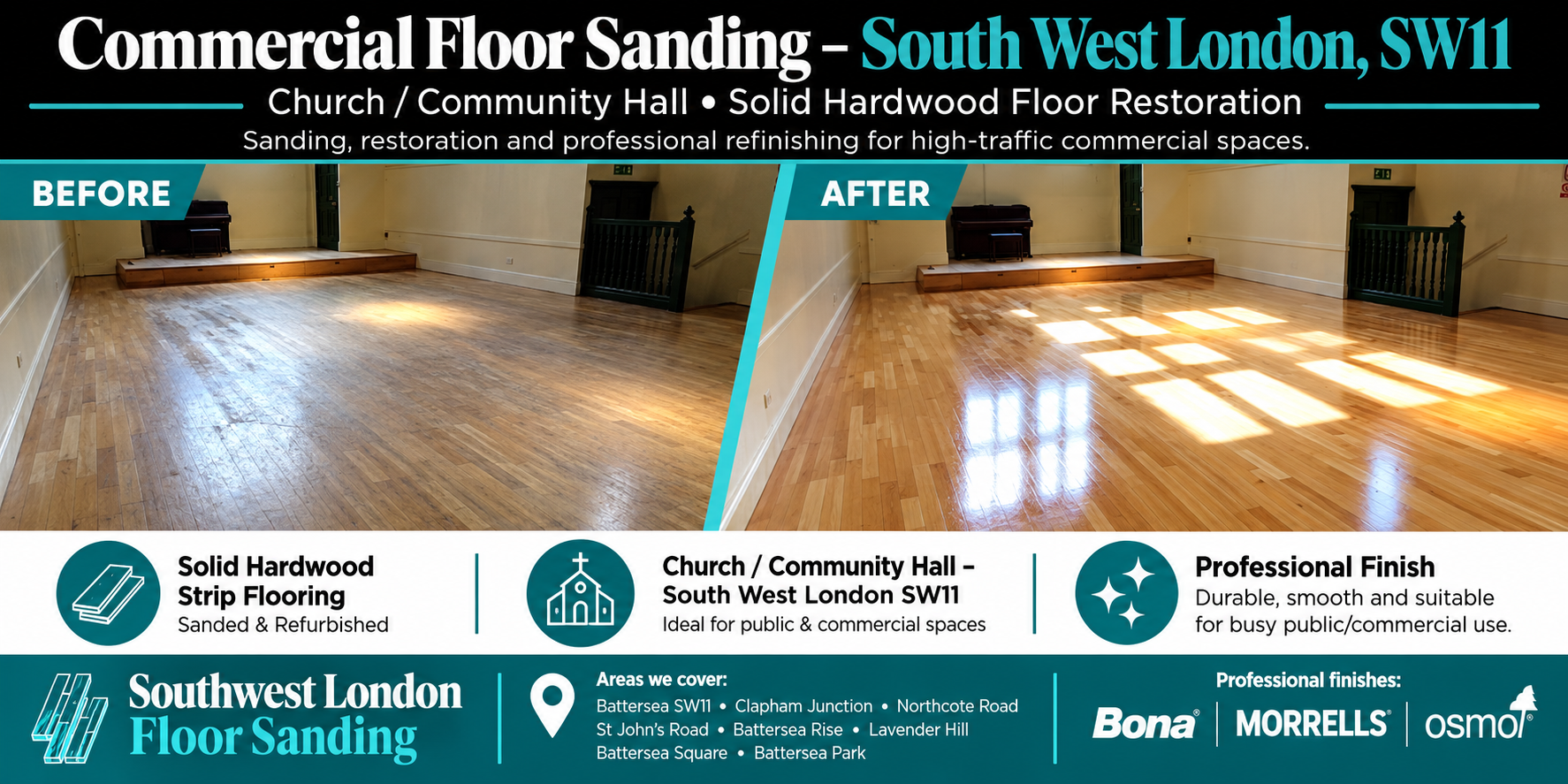
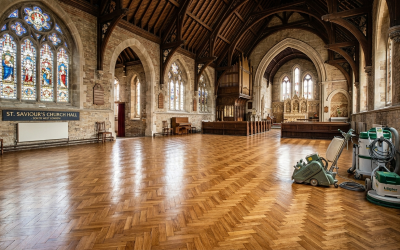
Church and community hall hardwood floor sanding in South West London SW11, showing the worn strip flooring before restoration and the bright, smooth finish after professional sanding and refinishing.
Cure Times, Reopening and Foot Traffic
“Dry” and “fully cured” are not the same thing. A waterborne 2K lacquer may become suitable for light foot traffic relatively quickly under the correct temperature and ventilation conditions, while full chemical and mechanical resistance takes longer to develop.
For that reason, we agree the handover sequence before work starts. Pedestrian access, furniture replacement, rubber-backed matting, wheeled loads and wet cleaning may each have different restart times depending on the product specified.
Trying to shorten a manufacturer’s cure schedule because a site is busy is false economy. Premature chair movement or wet cleaning can mark a coating before cross-linking has developed properly, leaving a floor that needs remedial work almost immediately.
Slip Resistance and Commercial Health & Safety
Commercial flooring has to be considered as part of the site’s wider risk assessment. Entrance water, grease, cleaning residues and worn coatings can all alter the way a timber floor behaves underfoot.
Where objective slip-resistance data is needed, Pendulum testing is the recognised UK route and is described by BS 7976 methodology and UK slip-resistance guidance. We do not describe a glossy coating as “anti-slip” simply because it feels acceptable when dry; the environment and likely contamination have to be considered.
Before commercial work begins, project documentation can include RAMS covering the sanding sequence, machinery, dust control, manual handling, electrical equipment, access restrictions and emergency arrangements. COSHH information addresses coatings, adhesives, cleaning agents and process-generated contaminants such as wood dust.
For occupied projects, access control and dust separation are agreed with the facilities manager or principal contractor. Where required by site rules, this can include CSCS-carded operatives, induction compliance and coordination with permit-to-work or contractor-management procedures.
Why Product Compatibility Matters
Floor failures are often blamed on the finish when the real fault sits underneath it. A high-specification lacquer applied over silicone contamination, wax residue, uncured filler or an incompatible old coating can fail no matter how expensive the product was.
The same applies to adhesives. A loose parquet floor needs an adhesive compatible with the substrate, timber species, existing residues and expected movement; simply injecting a rigid glue into every hollow block is not a professional repair strategy.
When low-emission materials are specified, EC1 Plus-rated installation products provide a useful benchmark for very low emissions. Product selection still has to account for bond strength, substrate preparation and the manufacturer’s system requirements rather than treating the label as a substitute for correct installation.
Local Commercial Floor Restoration Across SW11
We work across Battersea, Clapham Junction and the wider SW11 district, including commercial premises around Northcote Road, Battersea Rise, St John’s Road, Lavender Hill, Falcon Road and the streets surrounding Battersea Park. These areas contain everything from compact Victorian shop units to converted townhouses, larger institutional buildings, hospitality premises and modern commercial developments.
Older timber close to the Battersea Park, Battersea Square and Clapham Junction conservation areas deserves a measured approach. In many cases the right repair, controlled sanding sequence and modern protective coating will retain far more character than wholesale replacement.
Commercial Surveys, Quotations & Site Planning
A useful commercial quotation needs more than a square-metre figure. We need to know the floor construction, current coating, repair requirement, access conditions, working hours and the point at which the premises must return to normal use.
An initial assessment can often be made from clear photographs or a short video showing the entire floor, damaged areas, thresholds and access route. For larger or technically sensitive sites, we follow this with a physical survey before finalising the specification and programme.
Commercial liability insurance documentation, RAMS and COSHH information can be coordinated for the site file where required. Access requirements, CSCS provisions, parking or loading restrictions and any induction arrangements should be raised before mobilisation rather than on the morning the job starts.